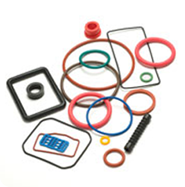
Material
Property NECSVPFAK
Abrasion ResistanceGGEGPGEPGEP
Acid ResistanceFGFGFGEPFGEE
Chemical ResistanceFGEFGGEEFGEEE
Cold ResistanceGGEFGEPFGGEPPF
Dynamic PropertiesGEGEFPGEEPGF
Electrical PropertiesFGFEFFGEEE
Flame ResistancePPGFEPGEE
Heat ResistanceGEGEEFEEE
ImpermeabilityGGGPGGPGG
Oil ResistanceEPFGFGEGGEE
Ozone ResistancePEGEEEEEEE
Set ResistanceGEGEFGEGEFGEGG
Tear ResistanceFGGEFGPFGEPPFPF
Tensile StrengthGEGEGPGEEFFGFG
Water ResistanceFGEFFFGPFGEGE
Weather ResistanceFEEEEEEEE

N Nitrile   E EPDM   C Neoprene   S Silicone
V Viton   P Polyurethane   F Fluorosilicone   A Aflas   K Kalrez
E Excellent   G Good   F Fair   P Poor

Materials are listed in order of least to most expensive.

Nitrile (Buna-N, NBR)
Nitrile rubber is the general term for acrylonitrile butadiene terpolymer. The acrylonitrile content of nitrile sealing compounds varies considerably (18% to 50%) and influences the physical properties of the finished material. The higher the acrylonitrile content, the better the resistance to oil and fuel. At the same time, elasticity and resistance to compression set is adversely affected. In view of these opposing realities, a compromise is often drawn, and a medium acrylonitrile content selected. Nitrile has good mechanical properties when compared with other elastomers and high wear resistance. Nitrile is not resistant to weathering and ozone.

Heat resistance Cold flexibility Chemical resistance Not compatible with:

EPDM (Ethylene Propylene, EPM)
EPM is a copolymer of ethylene and propylene. Ethylenepropylene-diene rubber (EPDM) is produced using a third monomer and is particularly useful when sealing phosphate-ester hydraulic fluids and in brake systems that use fluids having a glycol base.

Heat resistance Cold flexibility Chemical resistance Not compatible with:

Neoprene (Chloroprene, CR)
Neoprene was the first synthetic rubber developed commercially and exhibits generally good ozone, aging and chemical resistance. It has good mechanical properties over a wide temperature range.

Heat resistance Cold flexibility Chemical resistance Limited compatibility Not compatible with:

Silicone (VMQ)
The term silicone covers a large group of materials in which vinyl-methyl-silicone (VMQ) is often the central ingredient. Silicone elastomers as a group have relatively low tensile strength, poor tear and wear resistance. However, they have many useful properties as well. Silicones have good heat resistance up to 450°F (232°C), good cold flexibility down to –75°F (–59°C) and good ozone and weather resistance as well as good insulating and physiologically neutral properties.

Heat resistance Cold flexibility Chemical resistance Not compatible with:

Viton (Fluorocarbon, FKM)
Fluorocarbon rubber has excellent resistance to high temperatures, ozone, oxygen, mineral oil, synthetic hydraulic fluids, fuels, aromatics and many organic solvents and chemicals. Low temperature resistance is normally not favorable and for static applications is limited to approximately –15°F (–26°C) although in certain situations it is suitable down to –40°F (–40°C). Under dynamic conditions, the lowest service temperature is between 5°F and 0°F (–15°C and –18°C). Gas permeability is very low and similar to that of butyl rubber. Special fluorocarbon compounds exhibit an improved resistance to acids, fuels, water and steam.

Heat resistance Cold flexibility Chemical resistance Not compatible with:

Polyurethane (AU, EU)
One must differentiate between polyester urethane (AU) and polyether urethane (EU). AU type urethanes exhibit better resistance to hydraulic fluids. Polyurethane elastomers, as a class, have excellent wear resistance, high tensile strength and high elasticity in comparison with any other elastomers. Permeability is good and comparable with butyl rubber.

Heat resistance Cold flexibility Chemical resistance Not compatible with:

Fluorosilicone (FVMQ)
Fluorosilicone rubber contains trifluoropropyl groups next to the methyl groups. The mechanical and physical properties are very similar to silicone rubber. However, fluorosilicone offers improved fuel and mineral oil resistance but poor hot air resistance when compared with silicone.

Heat resistance Cold flexibility Chemical resistance

Aflas (Tetrafluoroethylene Propylene, FEPM)
This elastomer is a copolymer of tetrafluoroethylene (TFE) and propylene. Its chemical resistance is excellent across a wide range of aggressive media.

Heat resistance Cold flexibility Compatible with: Not compatible with:

Kalrez (Perfluoroelastomer, FFKM)
The name "perfluoroelastomer" is somewhat misleading. An actual perfluorinated material with a high molecular weight is polytetrafluoroethylene or PTFE which has the chemical formula "(CF2)n." The molecular carbon chain is shielded by the chemical inertness of the large bonded fluorine atoms. Perfluoroelastomer is produced by the copolymerization of tetrafluoroethylene (TFE) and a perfluorinated ether, e.g. perfluoromethylvinylether (PMVE). The differing resistance to volume swell of the different perfluoroelastomers is due to the perfluorinated ether element, where the side-chain can consist of up to four perfluorinated carbon atoms. The extraordinary chemical resistance is partly due to the fluorine atoms shielding the carbon chain, and partially due to the vulcanization system.

Heat resistance Cold flexibility Chemical resistance Not compatible with: